|
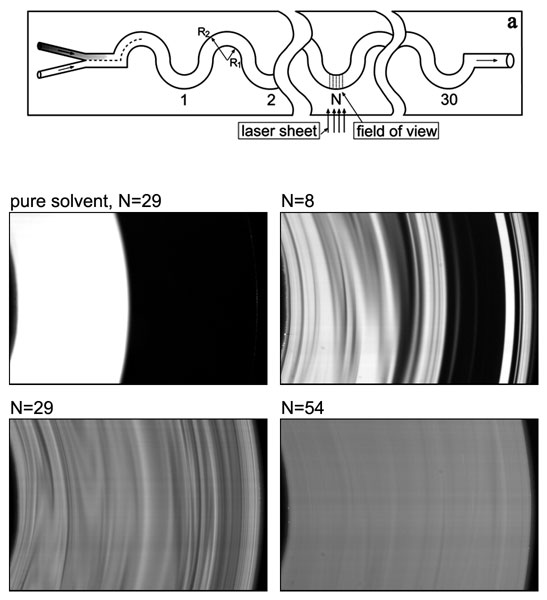
A schematic drawing of a curvilinear channel used in the mixing experiment (above) and snapshots of mixing at different stages (Groisman and Steinberg, Nature 2001). The channel is d = 3 mm deep, machined in a transparent bar of Plexiglas and sealed from above by a transparent window. It consists of a sequence of smoothly connected half-rings with the inner and outer radii R1 = 3 mm and R2 = 6 mm, respectively. Two liquids are fed into the channel by two syringe pumps at equal discharge rates through two separate inlets. The two working liquids are always identical with the only difference of a small amount of a fluorescent dye (fluorescein) added to one of them. The channel is illuminated from a side by a laser beam converted by two cylindrical lenses to a broad sheet of light, which is about 40 m thick. The fluorescent light emitted by the liquid in the perpendicular direction is projected onto a CCD camera. Brightness is proportional to concentration of the dye. The flow is always observed near the middle of a half-ring close to the side from which the laser beam comes. So, the number, N, of a curved segment is a natural linear coordinate along the channel. The flow is always at low Reynolds numbers, Re < 1. Thus, if the liquid does not contain polymers (the viscous Newtonian solvent, 63% sugar and 1% NaCl in water), the flow remains laminar. No mixing occurs in that flow and the dye distribution at the end of the channel is almost the same as near the inlets (the photo at the top left). However, an addition of 80 ppm of a high molecular weight polymer makes the liquid elastic that changes the situation completely. The laminar flow becomes unstable at low Re, and a random secondary flow develops, which resembles the elastic turbulence. This irregular 3D flow stirs the liquid (photos at N = 8 and 24) and provides quite an efficient mixing. Thus, at the end of the channel, at N = 54, the dye distribution becomes rather homogeneous (the photo at the bottom right). |
 |